
 +351 963 509 874
 mail@funpadel.pt


 4.28
4.28
 Bestseller



Bandeja, Víbora, and Smash in Padel: Overhead Shots Guide
 7 min
7 min
- Why these shots are important
- How to execute the bandeja
- Preparation and body position
- How to execute the víbora
- How to apply spin
- When to use the víbora
- How to execute the smash
- Power smash
- Smash por quatro
- Differences between the three shots
- Which shot to choose in each situation
- Most common technical errors
- Exercises to improve execution
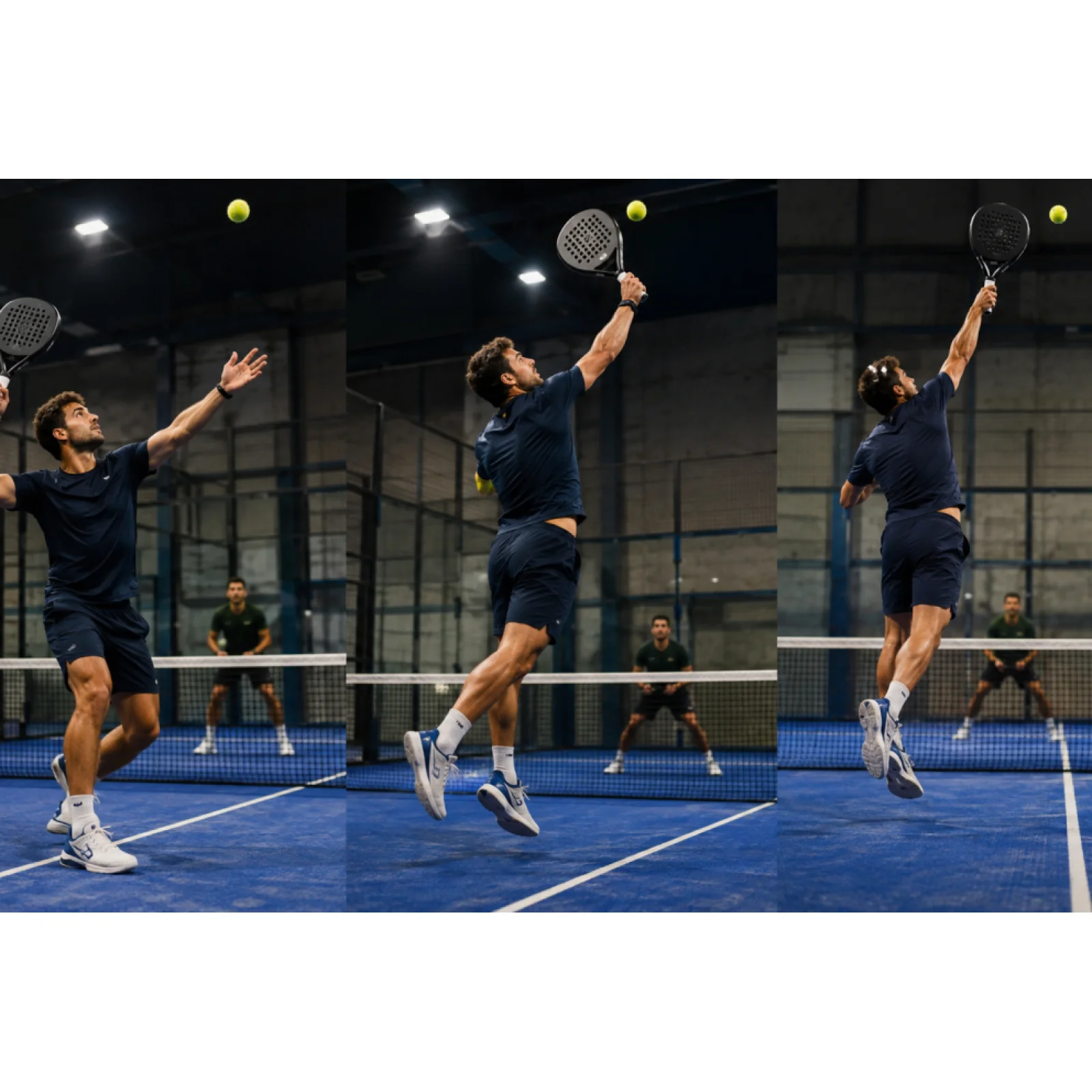
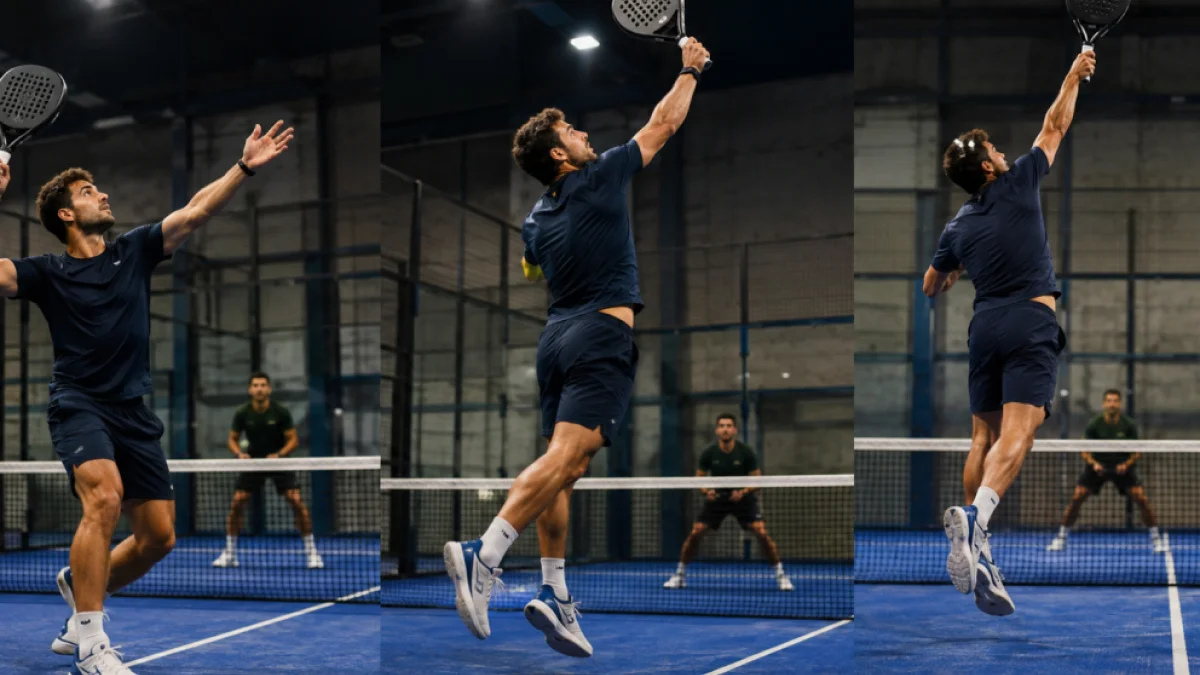
The bandeja, the víbora, and the smash are overhead shots, but they serve different functions. The choice depends on the height and depth of the ball, the position, the time available, and the tactical objective: preserving the net, increasing pressure, or seeking the finish. In padel, the bandeja favors margin and control, the víbora adds speed and spin, and the smash assumes a more offensive intention. Execution improves when preparation, contact, balance, and position recovery are practiced together.
Why these shots are important
The three shots frequently occur when the opposing pair plays a lob to push back those occupying the net. An adequate response allows maintaining an offensive position without offering an easy ball or losing the initiative. The bandeja tends to favor continuity and depth, the víbora seeks to create greater pressure with direction and spin, and the smash may attempt to close out the point. The difference begins with reading the trajectory, adjusting the feet, and making the decision prior to contact.
How to execute the bandeja
The bandeja in padel is primarily a control shot, used when a lob forces a retreat and does not offer clear conditions for an offensive smash. The objective is usually to return the ball with margin, depth, and direction in order to maintain or recover the position near the net. The technique combines lateral preparation, adjusted footwork, and moderate acceleration. Instead of forcing speed, it is important to control the trajectory and finish with balance, allowing the pair to reorganize.
Preparation and body position
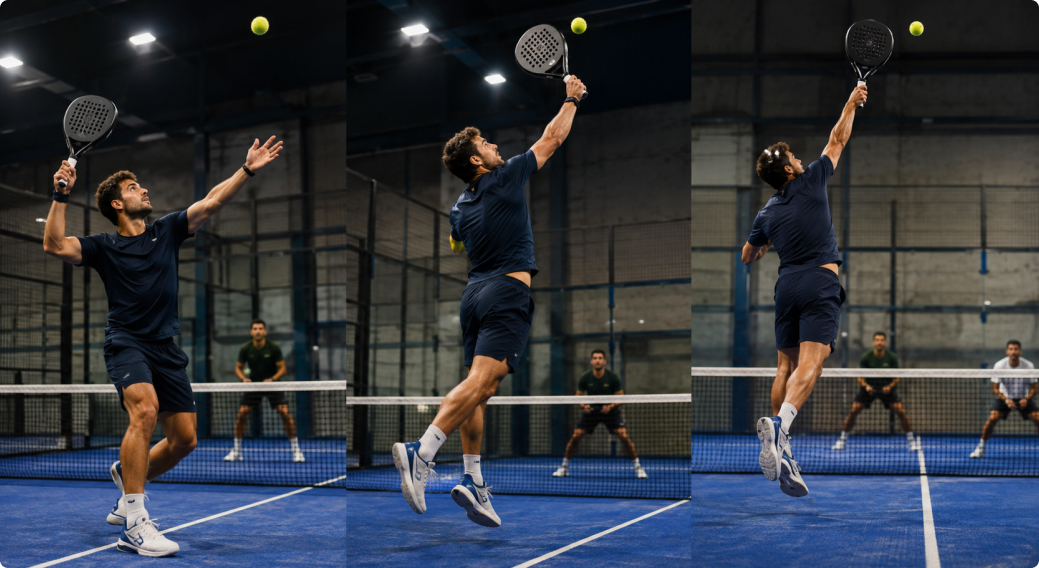
Movement begins with adjustment steps and shoulder rotation, leaving the body partially sideways relative to the ball. The racket rises early, the non-dominant arm helps calculate the trajectory, and the footing remains active to adjust distance.
Point of contact
Contact tends to occur above shoulder level, slightly to the side and in front of the body, although the height varies with the incoming ball and the technical choice. Leaving it too far back reduces control and can cause compensations with the shoulder, arm, or wrist.
Direction and depth
A deep bandeja toward the corner, the center, or near the line can limit the opponent's initiative. The diagonal generally offers a greater margin, but the direction must take the opponents into account; after the shot, it is important to recover the net with the partner.
How to execute the víbora
The víbora in padel is normally more aggressive than the bandeja and combines acceleration with side or mixed spin. It is used when the ball allows putting pressure on the defense, but does not necessarily offer a safe opportunity to finish the point. The preparation may look similar to that of the bandeja, but the racket trajectory and body rotation tend to generate a faster and lower ball. The spin should not rely solely on the wrist: it results from coordination between the legs, torso, shoulder, forearm, and arm.
Movement and rotation
The player sets up sideways, prepares the racket above the shoulder line, and adjusts distance with the feet. During the stroke, the rotation of the torso accompanies the weight transfer and acceleration, while the arm finishes in front without compromising balance.
How to apply spin
Spin arises from the combination of the racket's direction, the orientation of the face, and the point of contact on the ball. An oblique pass can generate side or slice spin, but a jerky wrist movement reduces precision; the amount of spin must adjust to the intended direction.
When to use the víbora
The víbora can be appropriate facing a relatively high and short ball, when there is time to prepare and attack from a stable position. It can be directed to the corner, the body, or the center to condition the defense, without guaranteeing the conclusion of the point.
How to execute the smash
The smash in padel is the overhead shot with the most offensive intention. In general, a high contact in front is sought, with acceleration resulting from coordination between the legs, torso, shoulder, and arm. Not every lob justifies a smash. A position far from the net, a delayed contact, or a lack of balance can facilitate the opponent's response. The type of smash depends on height, distance, available direction, and the possibility of recovering if the ball returns.
Power smash
The power smash seeks to impart high speed to the ball and reduce response time. It can be flatter or incorporate spin; in some executions, after bouncing in the opponent's court and hitting the back wall, the ball returns over the net. The result depends on contact height, distance to the net, and precision.
Smash por três
In the smash por três, the ball bounces in the opponent's court and passes over the three-meter-high side fence. The shot is frequently cross-court and can combine power and spin, but the exit does not make the ball unreachable: when play outside the court is authorized, the opponent can exit the enclosure and attempt to return it.
Smash por quatro
In the smash por quatro, the ball bounces in the opponent's court and passes over the back fence, which has a total height of four meters. This trajectory usually requires a high contact and a favorable position, often close to the net; the expression does not refer to the number of bounces.
Differences between the three shots
The choice becomes clearer when comparing the main function and execution conditions: the bandeja favors control, depth, and preservation of position at the net; the víbora adds pressure through acceleration, direction, and spin; the power smash seeks to accelerate the ball and make the response difficult or impossible; the smash por três seeks the exit over the side fence after the bounce; the smash por quatro seeks to clear the back fence; risk increases when forcing a shot incompatible with height, balance, or position. These differences do not form a fixed difficulty scale. A well-placed bandeja can be more effective than a rushed smash, while a víbora loses value when preparation is late or the pair does not recover the offensive position.
Which shot to choose in each situation
Facing a deep lob and a less favorable position, the bandeja generally offers more margin to preserve the net. When the ball stays shorter and there is time to create spin and pressure, the víbora may be appropriate; facing a high and stable contact, the smash becomes a more offensive option. The decision also depends on speed, playing side, opponents, and the consistency of each execution. It is advisable to choose the shot that allows controlling the subsequent response, rather than always seeking the highest power solution.
Most common technical errors
Among frequent errors are late preparation, incorrect distance, contact behind the body, loss of balance, and excessive use of the arm or wrist. It is also common to apply the same movement to all three shots or to force power without considering height and position. Another error is observing only the result of the attack and not recovering position. After execution, the pair must reorganize, advancing if the shot maintains pressure or preparing defense if the response neutralizes it.
Exercises to improve execution
Training can begin with shadow swings and series with balls fed in a controlled manner by a coach or partner. First, preparation and contact are worked on; then targets, depths, movement, and recovery to the net are added. In a subsequent phase, it is advisable to alternate bandeja, víbora, and smash without previously announcing the trajectory. This exercise brings practice closer to real decision-making: it forces reading the ball, adjusting footwork, and choosing the execution, rather than repeating the same shot.
Be the first to know what's happening in padel
Subscribe for gear guides, playing tips and the latest padel news — straight to your inbox.
 Iryna Mykhalchuk
 Fast delivery: 2–3 business days
 The best prices on the web
 30 days to return the product
 Helpful customer support
